
متن انگلیسی سند :
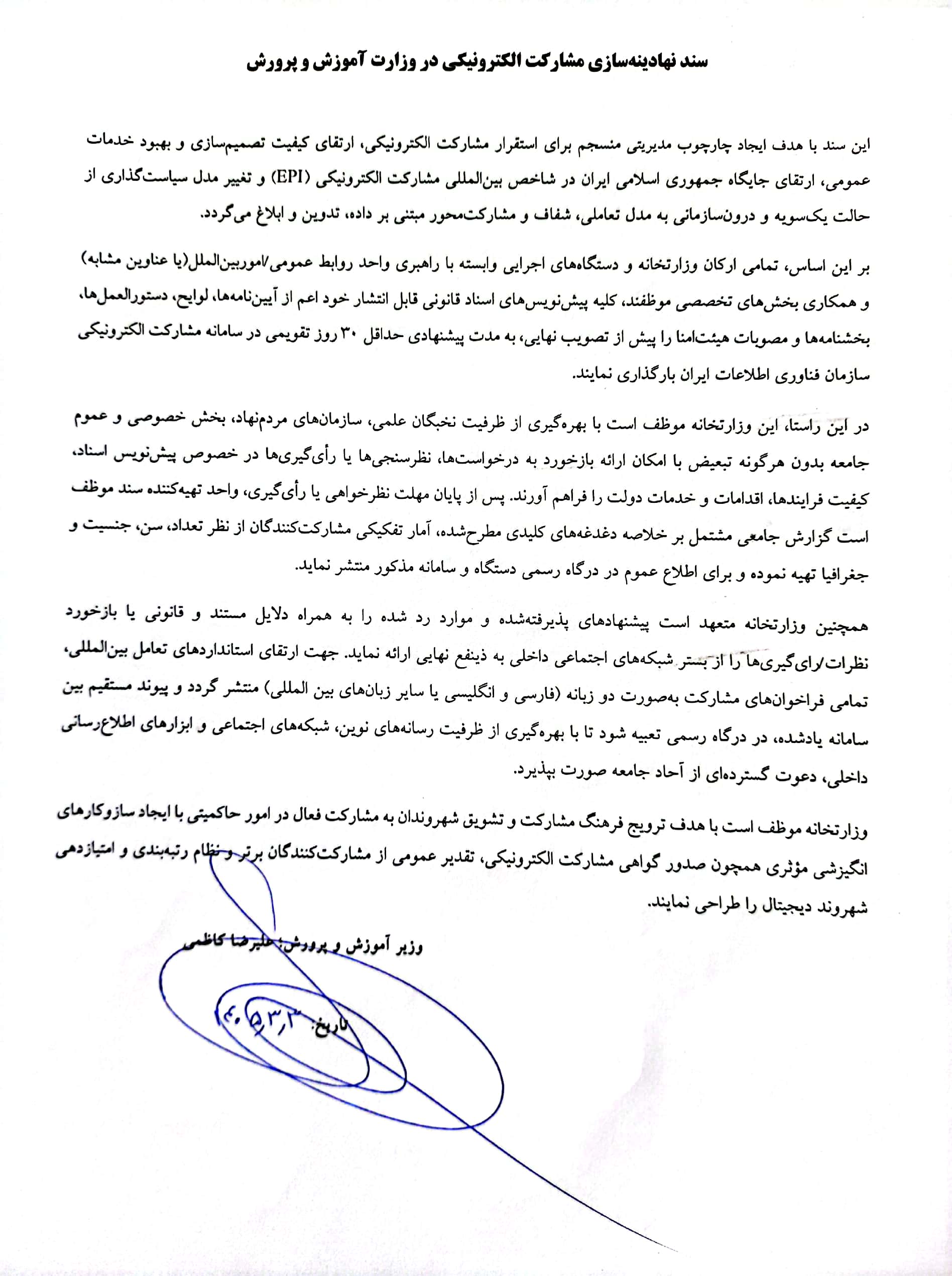
This document is developed and communicated with the aim of establishing a coherent management framework for the implementation of electronic participation, enhancing the quality of decision-making and public services, improving the position of the Islamic Republic of Iran in the international Electronic Participation Index (EPI), and shifting the policy-making model from a unilateral, internal approach to an interactive, transparent, and data-driven participatory model.
Accordingly, all components of the Ministry and its affiliated executive bodies, under the strategic guidance of the Public Relations / International Affairs unit (or equivalent titles) and in collaboration with specialized departments, are obliged to upload all publicly releasable drafts of legal documents — including regulations, bills, guidelines, circulars, and board of trustees’ approvals — to the electronic participation system of the Iran Information Technology Organization for a proposed minimum period of 30 calendar days before final approval.
In this regard, the Ministry is required to leverage the capacities of academic experts, non-governmental organizations, the private sector, and the general public without any discrimination, by enabling the provision of feedback on requests, surveys, or votes regarding draft documents, thereby improving the quality of government processes, actions, and services. After the end of the consultation or voting period, the unit that prepared the document must produce a comprehensive report summarizing the key concerns raised, along with disaggregated statistics of participants by number, age, gender, and geography, and publish it on the official portal of the Ministry and the aforementioned system for public information.
Furthermore, the Ministry undertakes to communicate accepted suggestions and rejected cases, together with documented legal justifications or feedback on comments/votes, to the final beneficiaries through domestic social media platforms. To raise international interaction standards, all calls for participation shall be published bilingually (Persian and English or other international languages), and a direct link to the said system shall be embedded on the official portal, so that a broad invitation to all segments of society can be made using modern media, social networks, and domestic information tools.
The Ministry is also tasked with promoting a culture of participation and encouraging citizens to actively engage in governance affairs by designing effective incentive mechanisms, such as issuing electronic participation certificates, publicly acknowledging top participants, and establishing a digital citizen ranking and scoring system